Friday, 31 October 2014

The Orchard by Theresa Weir


The Orchard by Theresa Weir
   In preparation for our book club discussion of "The Orchard", I have been thinking about the different covers.  I love this cover, because it centres on the love story that is at the 'core' of the novel.  The orchard surrounds the couple and there is a swirling design around the page.  Does that represent the pesticides?  There seem to be nozzles at the top and bottom.  If so, it may to be showing the illusion of the perfect orchard.  The reality is that the pesticides are killing not only fish and plants, but people also.  But this novel has a fairy tale quality with the aspect of magic and enchantment.  As you read this book, you hope for the happy ending, but know that it cannot happen.
  The author admits to have written the book in order to illuminate environmental concerns. But this is actually her biography.  She did live on an orchard and speaks of the farming practices in 1996.


   This second cover presents only the story of the apple, but you can see that the apple is not going to be eatable.  Perhaps this cover is more simple and profound.  However, it is the personal story that I was drawn to and this cover doesn't nearly represent the book as I experienced it.
  Concerns about chemicals are not new. In 1962, Rachel Carson's book "Silent Spring" really caused a 'stir'.  She wrote in a very different fashion.  From her experience as a marine biologist, she wrote facts and really attacked the use of DDT.  The chemical industry spent 1/4 million dollars to discredit her and her research.  However, the then-president of the U.S.- John F. Kennedy paid attention and ordered investigations, which led to the banning of DDT.  This was called 'the book that changed the world'. Part of this article is shown here.  Unfortunately, the middle of the story is missing.


Tuesday, 28 October 2014

Living with Joy

  "Until I Say Good-Bye:
My Year of Living With Joy"
  by Susan Spencer-Wendel
   This book, recommended by a friend, was a great discovery!  Particularly at this time of year.  This is an autobiography of Susan, who died of ALS at 47.  That is the age our son was when he died last year.  So, on the anniversary, it is very helpful to read about Susan's uplifting thoughts, beginning with this great poem:

        Happy the Man
Happy the man, and happy he alone,
He who can call today his own:
He who, secure within, can say,
Tomorrow do thy worst, for I have lived today.
Be fair or foul or rain or shine
The joys I have possessed, in spite of fate, are mine.
Not Heaven itself upon the past has power,
But what has been, has been, and I have had my hour.
                     John Dryden

   Susan was a journalist with three children when she was diagnosed with ALS.  She realized that she may only have a year of reasonable health, so she decided to live it with joy.  She organized trips to the Yukon, Hungary, the Bahamas, and Cyprus with the people who were important in her life.  And, like a good journalist, she wrote about her experiences.
   Her book is enormously inspirational- from reminders to look up and appreciate the sky, to quotes such as this one from Dr. Seuss: "Don't cry because it's over.  Smile because it happened."
   The first chapter is about swimming with the dolphins with her nine-year-old son and the last chapter is about a trip to Sanibel Island, Florida, with her 11-year-old son.  The trips were not ideal- many things went wrong.  But Joy's attitude surmounted every disaster.  She knew that events rarely happen as anticipated, but they are perfect moments nevertheless.  She accepted life the way it happened.  Her advice: "Don't force the world to be the one you dream.  The reality is better".
   As her health deteriorated, she was writing with one thumb on her iPhone.  She did finish the book and lived to see it published.

"Every day is better when it is lived with joy".

Friday, 24 October 2014

Food for Thought

Thought for Today:

Readers may be divided into four classes:
1. Sponges, who absorb all that they read and return it in nearly the same state, only a little dirtied. 
2. Sand-glasses, who retain nothing and are content to get through a book for the sake of getting through the time. 
3. Strain-bags, who retain merely the dregs of what they read. 
4. Mogul diamonds, equally rare and valuable, who profit by what they read, and enable others to profit by it also. Samuel Taylor Coleridge, poet, critic (1772-1834) 


Next week I will be leading the discussion in two book clubs so I am working on the challenges of number four, mulling over the best way to profit from a book.

Monday, 20 October 2014

North Dakota, 1951

   I read about this book on a blog that I follow.  It seemed like a great change for me.  North Dakota.  I loved driving through that state.  It seemed to be a journey book and I was hoping to recapture the feel of North Dakota.  I was unfamiliar with the author.
   Well,  it certainly did make me feel that I was traveling in North Dakota.  The writing was so descriptive! This author can certainly write!
   There were not many characters in the novel, but there were some to love and some to hate.  Love that!  And the writing enabled me to really get to know all of them.  Margaret and George Blackledge are the main characters- grandparents to a little boy.  After their son died, their daughter-in-law lived with them for awhile until she was swept off her feet by Donnie Weboy, who took the boy and his mother to live with his 'clan' in Montana.  Well, Grandma is worried about the grandson and sets off to bring him home.
   Margaret, the grandmother, was described this way: "A woman willing to plunge into any water, no matter how icy or swift, if she has a reason to get to the other side."  But can she take on 'the Weboy tribe'?
  I found myself completely drawn into this story.  Beautiful language!  But..but..but.  What has happened to quotation marks?????
 

Friday, 17 October 2014

cookbooks

   Some people collect cookbooks.  I have never done that.  I am not great in the kitchen and the only cookbooks that I recall buying were "Magnificent Cookies Cookbook" and "Simply Souper".  I used to bake a lot of cookies and I loved making soup.
   But this is a cookbook that I wish I had bought.
"Fresh From the Farm: a year of recipes and stories".

   We visited the author, Susie Middleton, on her farm when we were on Martha's Vineyard.  She is a fascinating woman who has a great story to tell.  And she tells about it in this cookbook.  Susie had a corporate job, but finds much greater satisfaction from life on the farm.  She grows fruit and vegetables and writes great recipes for preparing them.  She has added chickens and cannot keep up the demand for fresh eggs.


  This little store on her property gives local people a chance to buy her produce.  It is run on the honour system.  Help yourself.

   Some of our group bought her book "Fresh From the Farm" and report that the book explains techniques for cooking vegetables that you can use often.  The gingery brussel sprouts and roasted broccoli florets tasted great and the recipes were easy to follow.  
  I have just discovered that this book is in the library so I will check it out and try some of the recipes and also read about Susie's mid-life change in career.
   Then I may decide to buy it.


Sunday, 12 October 2014

Martha's Vineyard- afterthoughts


                    Here are my fellow 'Bookwomen' in Edgartown Inn in Edgartown, Martha's Vineyard.

 While on my "Bookwomen" experience in Martha's Vineyard, our group met 6 authors, a publisher, 2 book store owners, a curator at the museum, and a spokeswoman for the Wampanoag people.  All these women added to our understanding of the island and its history.


Laura Wainwright
view from Laura's house

Laura Wainwright invited us to her home for freshly-made pie.  She has written a delightful book of essays on daily life on Martha's Vineyard- "Home Bird".  The recipe for the cranberry pie came from her book and was delicious!
She chatted with us by a fire.  So cozy!  Just like her book!


We met June Manning at the Aquinnah Cliffs where there were some shops run by the Wampanoag people. She spoke eloquently about the Wampanoag people who lived on Martha's Vineyard when the Pilgrims arrived in 1620.
We had discussed "Caleb's Crossing" by Geraldine Brooks, where the Wampanoag people were important to the story.  So, it was interesting to hear from this very involved Wampanoag woman about the life of her people on Martha's Vineyard today.


Cynthia Riggs is a fascinating woman who writes a murder mystery series with a 92-year-old sleuth.  Cynthia is working on the twelfth book in the series. She talked about writing, not from a summary or plot but just as the story comes into her mind.  Her characters are based on real people and she is often seen wearing a shirt that says: "Careful or you'll end up in my novel".  Loved her!


This beautiful room was the setting for a talk by Shirley Mayhew, a photographer/writer, and Susanna Sturgis, whose novel "Mud of the Place" was one of our discussion books.


The 'Bookwomen' greatly enjoyed the 5-day event on Martha's Vineyard with so many rich experiences!
Our thanks to 'Bookwomen' organizer, Molly Hoban.
Molly is the co-founder of Minnesota Women's Press in St. Paul, Minnesota.  She creates these 'Bookwomen' opportunities for women to meet, read, learn, write , talk and explore.
Thanks, Molly!

Friday, 10 October 2014

Martha's Vineyard : Book 5

"Caleb's Crossing" by Geraldine Brooks takes place on Martha's Vineyard in 1660.  It follows a group of Puritans that broke away from the larger Massachusetts settlement.
It is a fictional account of Caleb, the first Native American to graduate from Harvard College.
The story is told by Bethia, the daughter of the preacher, who believes herself to be very sinful because she loves nature and has a great thirst for knowledge.  She also has great ability in language and learns to communicate with the Wampanoag.


Geraldine Brooks
Geraldine Brooks was born in Australia
and now lives on Martha's Vineyard.
She has written 6 books, winning the Pulitzer Prize in 2006 for "March".

I had previously read "Caleb's Crossing" and was happy to re-read it for this event.
I had also read these books by Geraldine Brooks:


"March" by Geraldine Brooks
Louisa May Alcott fictionalized her life in her novel "Little Women" written in 1868.  Geraldine Brooks took the story of Alcott's father, Bronson Alcott, and fictionalized that.
Actually, Bronson Alcott never did go to war, but it made an interesting narrative to put this man with abolitionist and transcendental convictions into the role of a union chaplain.  He ended up in spiritual torment, but wrote beautiful letters home to his family.
I read this book in 2012 for a book club.
It is a fascinating novel.  The story is not linear and is a little confusing but I appreciated the way Brooks put words together.


"Nine Parts of Desire: The Hidden World of Islamic Women"
I read this when it came out in 1995.   It was fascinating and disturbing.
The title comes from Muhammad's son-in-law who said, "Almighty God created sexual desire in ten parts; then he gave nine parts to women and one to man".
This is completely non-fiction, with a great deal of research, giving great insight into the women in the Middle East.
It explains honor killings, death for homosexuals, and clitoridectomy- all horrific subjects.
Very well- written.


I programmed these blogs to be posted while I was away. 
I will return from Martha's Vineyard by the next posting.

Monday, 6 October 2014

Martha's Vineyard : Book 4

author Dorothy West
"The Wedding"
by
Dorothy West
(1907 - 1998)
Dorothy was the last living member of the Harlem Renaissance.
She wrote her first story at 7 and continued writing short stories and publishing magazines. Her work is ground-breaking in her portrayal of African Americans.  She was one of the first black women to have her works published.
At 85, she finished her second novel "The Wedding".  It was made into a 2-part miniseries by Oprah Winfrey.
Dorothy dedicated her book to Jacqueline Kennedy Onassis, her editor, who died before the book was published.


This is a small but powerful book.  The story takes place in two days, but there are many back-stories of ancestors.
"The Wedding" is about to take place on Martha's Vineyard in the 1950's, where there really was a community of wealthy blacks in an area called "The Oval". The theme is very obviously bigotry- colour and social standing. "The right colour was preferable, but not as mandatory as the right class." But the book begins with a quote about love:
I Corinthians 13: 4-7. "Love is patient; love is kind; love is not envious or boastful or arrogant or rude.... It bears all things, believes all things, hopes all things, endures all things".
The marriages in the story are never based on love, but on what is 'needed' in a partner.
The writing is amazing!  Some sentences are so full of metaphors that it takes a few minutes to figure out what is being said.
The characters are compelling and strongly developed.  The message is strong!
About Shelby's marriage:  "That union in the time of generation, would return to its origination, the colored blood drained out, degree by degree, until none was left, either known or remembered."
About the future generation:
"I wanted to fight the whole white race for her but she must do it herself.  It's a private and internal struggle.  And to win she will have to fight back without bitterness, not replacing her hurt with hate but letting hurt enrich her experience."
Powerful novel!

Friday, 3 October 2014

Martha's Vineyard : Book 3

"The Mud of the Place" by Susanna F. Sturgis
The title comes from this quote by Grace Paley:
"If your feet aren't in the mud of a place, you'd better watch where your mouth is".


Susanna is a writer who lives on Martha's Vineyard.  She has written essays, reviews and poems for gay publications.
There are two gay relationships in this novel.


In the novel, one of the characters is commenting on a new book that has been published, describing it thus: "Nick's book has a moody monochromatic cover".
How's this for a moody, monochromatic cover?


  For the first half of this book, I felt that I was struggling through mud!  There is an overabundance of characters, an overabundance of plot lines, and an overabundance of description.
   I can't begin to describe the plot.  I will just say that it shows how difficult it was for gays and lesbians to keep a job in 1997, especially if that job involved children.
  All through the novel, you are expecting a 'big reveal'.  When it turns out that the protagonist is gay, it seems anticlimatic.  What's the big deal?  I guess that says a lot about how attitudes have changed.
  All in all, it was a sinister look at Martha's Vineyard.
"Most of us crawl around under our own little carapaces, and no one ever bothers to knock on the top.  No one cares what's going on inside.  Go through the motions, meet your obligations; that's all that really matters".
  In the acknowledgements, the author says that Martha's Vineyard is not an easy place to live.  How different from the last book -"Home Bird".

Monday, 29 September 2014

Martha's Vineyard : Book 2


Our booklist for BookWomen always includes books to familiarize us with the area.
This book is perfect for that!


"Home Bird: Four Seasons on Martha's Vineyard"
 by Laura Wainwright
This book contains 27 essays of everyday life on Martha's Vineyard.  The author is very poetic as she writes about birds, animals, sunsets, water, beachcombing, plants, trees.
"The vibrant world is always there.  It's just a matter of paying attention."


As some birds pass through Martha's Vineyard while others stay, so also, many visitors come for a season but leave. The author is a 'home bird'.  But she is a 'home bird' who is able to describe everyday life in beautiful lyrical ways.  Since food is very important to her life on Martha's Vineyard, she includes 8 of her favourite recipes.

This book not only familiarizes you with Martha's Vineyard, but it also helps you remember to connect with nature at every opportunity.

"Occasionally water and movement and beauty create an alchemy that is the closest I get to rapture".
Wow!  Rapture on Martha's Vineyard!  Can't wait to get there!

P.S. I just got more info about the trip and our group has been invited for tea with Laura Wainwright.  Fun!


Friday, 26 September 2014

Martha's Vineyard : Book 1

Martha's Vineyard
This month, I will be attending a 'Bookwomen' event on Martha's Vineyard.
"BookWomen' is the name of a bimonthly magazine created by The Minnesota Women's Press in St. Paul, Minnesota in 1985.
A year later, book groups began at this location and grew in popularity, leading to 'reading on the road' and 'book retreats'.
My friend Terri discovered this group and we recognized that we could combine our love of reading with our love of travel.  This will be our fourth event- having explored Arizona, North Carolina and Bath, England.


We have five books to read for this trip, where we will have discussions as well as meet authors and learn about the area.

I began my reading with "Death and Honesty" by Cynthia Riggs.
This author is most fascinating.  She was educated as a geologist, then taught at the Annapolis Sailing School.  She lived on a houseboat for 13 years while running the Chesapeake Bay Ferry Boat Company.  She wrote for the National Geographic Society and Smithsonian, spending two months living in Antarctica.  She also raised 5 children.
In her 60's she began writing novels about an amateur detective named Victoria Trumbull- age 92!


Last year, Cynthia, at 81, married a man that she had worked with sixty years ago.  They live on Martha's Vineyard and we have learned that we will be meeting Cynthia as well as discussing her books.


"Death and Honesty" is the seventh book in this detective series.  The eleventh book has just been released.  I have read that the author plans to write 20 books in this Victoria Trumbull detective series.  We could chose any book by this author, so I chose this book because of the cover!

I don't know much about mysteries but this novel has a few storylines with some interesting characters. The novel takes place in a week, with  3 murders.  The basic problem is a tax collector and 3 assessors who are skimming money off of the property taxes.  Also, a T.V. minister is running a porn scam.  Lots of action for a small town, but the 92-year-old sleuth solves the crimes and confronts the murderer on her own.
The language is simple and straighforward.  It was a fun read!

Monday, 22 September 2014

The Husband's Secret

"The Husband's Secret" 
by Liane Moriarty

   This author was recommended to me and I decided to start with this title.
   The premise was interesting.  A wife finds an envelop with a letter to be opened after her husband's death.  But he is alive and away on a business trip.  Tempting!   What to do????     

I raced through the first half of the book to find out what the letter said.  Then I really lost interest.  What was disclosed in the letter could never be resolved in any way and would just lead to misery for the rest of the story for all of the characters.


The ending was sadness added to sadness.  Do we ever really know anyone?  Can we ever atone for the sins of the past?  Can one sadness cancel another sadness?


The novel takes place in Australia and I was hoping for more description of the setting.  But the book was focussed on plot.  Very simple language and characters whose lives are all in turmoil.

Interesting covers!

Thursday, 18 September 2014

Ernest Gaines

   Oprah started her book club in 1996, just in time for my retirement!
  In 1997, while we were travelling, I decided to read to John one of Oprah's choices.
  "A Lesson Before Dying" had an intriguing title and a more intriguing concept.
   In the 1940's, a young black man, Jefferson, is about to go to the electric chair for murder. His grandmother wants her grandson to 'die like a man'.  So she begs the school teacher, Grant Wiggins, to teach Jefferson some self-esteem and pride in his identity as a black man.
   We both found this book fascinating and as we were finishing the trip, in the rain, I was trying to get the book finished, hoping that we wouldn't crash and I would be found reading this title.
   The book was so sensitively written, and later, when we rented the movie, we found it even more powerful emotionally.  The photography of that movie was stunning! 
   I wanted to read more by this author and "A Gathering of Old Men" appealed to me as a title.  So I have been searching for the book and finally found a copy.  It was written in 1983.


   Once again, Ernest Gaines, writes about the search for black, male identity. He shows the two extremes- revenge versus co-operation.
   A white woman, Candy, discovered a Cajun farmer had been shot in a black man's yard.  She enlisted the help of seventeen old black men, who all swear to killing the man, in order to protect the real killer from lynching.
   The victim's father, "Fix", is known to be explosive and he also has a ring of black men who are looking for revenge.  But Fix's other son is a football player who is part of a 'salt and pepper' team.  They work for racial harmony.  Fix is persuaded that times have changed and vigilante justice doesn't work anymore.
   There are many characters and lots of dialect to confuse this story. But there is real farce in the idea of a ring of old men with guns waiting for the other group of old men with guns.  And it is more amusing because most of the old men can't see well enough to shoot- or even stand long enough.  But they are willing to die for the cause of 'being a man' and not allowing lynching.


Sunday, 14 September 2014

To Read or Not to Read? That is the Question.

  This week I met a former colleague.  Our paths had not crossed for possibly 19 years.  Of course, our conversation turned to books.  She told me about this book that she has started reading.  I was fascinated, but when I picked up a copy, I discovered that it is 832 pages long- and heavy!
  So I began to read the reviews.
  The reason that I didn't dismiss it immediately is that I do enjoy a good challenge.  Getting involved in a well-written story can fill my thoughts and control my life.
                                                                   
The Luminaries
  What a compelling cover!  I love the phases of the moon and this looks like a fascinating twist.
And so I began to research.  If I am going to give hours and hours of reading and more hours of preoccupation to this book, I had better check to see if it is worth it.
  The internet said:
"The plot follows Walter Moody, a prospector who travels to the fledgling West Coast of the South Island settlement of Hokitika, near New Zealand's goldfields in 1866 to try and make his fortune. Instead he stumbles into a tense meeting between twelve local men, who draw him in to the complex mystery behind a series of unsolved crimes."
  Throughout the book are charts of the signs of the zodiac.  I did not understand them and thought perhaps that is a sign that this book is not for me.
But, but, but.  I have travelled the length of New Zealand and loved it.  I have not read much from that country.  And this book did win the Man Booker Prize last year.
Here are some comments by readers
- story leaps around through time sequences (NOT GOOD)
- long-winded and repetitive (NOT GOOD)
- too many characters (NOT NECESSARILY GOOD)
- the only luminous thing is the title, which doesn't suit (OOPS!)
- why did it win the Man Booker Award anyway?
To Read or Not to Read?  That is the Question.

Friday, 12 September 2014

Benny and Shrimp

   I enjoy checking other blogs and add them to my bookmarks bar to get the flavour of the blog.  After following them for awhile, I decide if I want to continue with that blog or move on to others.  There are tons!
  On one blog, I found a very interesting idea: a quilters' book club.  Every year, each member makes a quilt based on a book.  This weekend, they are planning to display the quilts.  Since my daughter is a quilter and I am a reader, it seemed like a perfect outing for us to enjoy together.  One problem- the display is in Oregon! In my fantasy world, I would hop on a plane and go to that exhibit.  But, in reality, I will wait until that blogger puts the quilts on her blog.  She has promised to do that.
Check out her blog here.

About the novel:
  A young, childless, widow meets a bachelor farmer at the cemetery.  They are complete opposites.  She is a librarian- loves literature and the opera.  He is a dairy farmer, just trying to keep the farm running by himself since his parents are both dead.  His house is old and fusty!  Her apartment is white, clean and modern.  The premise provides the opportunity for great humour!
  It's a very short, fun read!  But, the ending is..well, you want to read more!  The author tells you at the end that she has written a sequel.  But I cannot find any evidence of that on the internet.  Frustrating!
  The novel was made into a film in Sweden and won awards.  I want more!!!

About the author:  Katarina Mazetti lives in Sweden.  She has been a journalist, and a teacher, as well as a children's author.  This is her first adult novel.


Monday, 8 September 2014

You Are Made For More!


Everybody needs encouragement, support and inspiration.
My friend, Carol, recommended this book.
Carol and I are life-long friends who have discussed every issue known to man (or woman)-
well, maybe not quite. But, for a number of years, we had a book club that discussed spirituality and religion from every angle.  That book club was called "Left Field".

This book is one of the most mainstream Christian books that we have read.  Lisa's brother is the pastor of the largest Protestant church in the United States and is well -known for his positive thinking.  In fact, some people think he smiles too much. But I have always appreciated being reminded of the importance of staying positive.  One of my favourite books is "The Power of Positive Thinking" by Norman Vincent Peale.

The basic premise of Lisa Olsteen's book is that we are made for more than just surviving- we are made to thrive and flourish.
And so, she talks about things that can hold you back from the life you are meant to live.
Lisa, herself, has experienced some disappointments and heartbreak and has some great encouragement for every occasion.

Psalm 25: 12 "God will instruct you in the way chosen for you".

Reminders that I appreciated:
1.) Every season of your life has a purpose.
2.) You can look at difficulties as challenges.
3.) Nothing is impossible with God.
4.) Refuse fear- perfect love casts out fear.
5.) Simplify your life by simplifying your thoughts.
6.) Courage is a decision, not a feeling.
7.) Forgiveness is not an emotion but an act of the will.
8.) Believe the best in people.

Every life has a purpose.
Lisa often uses the phrase "What if"?  What if we didn't need to know everything?  What if we quit worrying?  What if we could do anything we wanted?  What would be a homerun for you?
These questions are interesting to ponder.
Lisa certainly gives you lots of encouragement, support and inspiration.  She reminds you to dream!  And expect more!


Tuesday, 2 September 2014

August 31

I usually try to post on my blog on Monday and Friday ( or close).
This past Monday was a holiday but that is not the reason that there was no post.
I don't usually get this personal, but here goes.
Sunday was the anniversary of our son's death, so we had 18 family members for supper on Saturday, to start the weekend.
I began to get sick as Saturday evening wore on and was very sick in the night- large swelling on my neck, high fever and terrible headache.  With the house full of people, I stayed in bed for three days.  When they realized how sick I was they went to other locations.
My sickness had all the symptoms of mumps and I decided to wait it out, but after three days in bed, unable to eat at all, or drink much, I was just too lifeless, and the pain in my ear was unbearable as the swelling got larger.  And so we headed for Emergency.

************************************************************************************

Kathy had made some entries into the Paris Fall Fair competitions- many are beautiful quilts, but she also entered in the storyboard category- photos that tell a story. Here is the one that she prepared in honour of her brother's journey.

Some friends and family members hiked along the Grand River early Sunday morning, also in memory of our son, and were shocked to find his initials, written in paint on a rock. Not one of them knew it was there.  They just happened on it by chance.  Or not chance?

Other family members hiked around Chicopee Park.  I haven't heard if they saw anything extraordinary.

************************************************************************************
Everyone has gone home, and I just got back from the hospital, with more tests planned and doctor's appointments to attend. I will also need time to gain my strength in order to begin feeling well and strong. The lump is still there but the pain is gone -thanks to the intervenous I received at the hospital.    It wasn't mumps, but what was it?  Some virus- from where?

Thursday, 28 August 2014

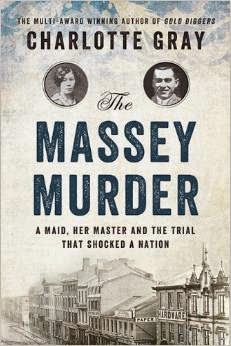
The Massey Murder- One Book, One Community


 2014 One Book One Community

   Charlotte Gray is a wonderful author. I greatly appreciate her writing style.  She is very organized and her sentences are beautifully written.  She does amazing amounts of research for her books and you can learn a great deal.
  This book is physically beautiful: the design of the cover, the quality of the pages, as well as the maps and charts - everything you could desire.
  But this book is so much more than the Massey murder. In order to understand the trial, you need to recognize how the young Dominion of Canada was reacting to the war in 1915.  Charlotte braided into the courtroom speeches the ideals of the war and Canada's involvement.  Brilliant writing!  And those speeches affected the outcome of the trial.
  Beyond that, the novel explores every inch of early 20th century Toronto- the families, the clubs, the streets, the buildings, the businesses, etc.  She is very thorough in her description, which may be delightful to read for those with an interest in Toronto.  But it may be overdone for those readers who were just interested in the murder story.
  I find an interesting comparison to "In the Skin of A Lion" by Michael Ondaatje, who also wrote about Toronto - more into the 1930's.  Michael focussed on the immigrants whose labour built the city, while Charlotte paints a picture of the upper class who ran the city.  There is a great contrast in the structure of the two novels.  Michael's novel is described as 'post-modern' because he uses many voices and moves and changes focus throughout.  But the two stories both have much to say about the early days of Toronto.
**************************************************************************************************************************
Charlotte Gray will be appearing in Kitchener , Waterloo, Cambridge and Elmira
 September 16, 17, 18.


Tuesday, September 16 – 7:00pm – Central Library, 85 Queen Street North, Kitchener
Wednesday, September 17 – 1:30pm – Elmira District Secondary School, 4 University Avenue, Elmira (the general public is welcome to attend this event!)
Wednesday, September 17 – 7:00pm – Knox Church, 50 Erb Street West, Waterloo
Thursday, September 18 – 7:00pm – Cambridge City Hall (Bowman Room), 50 Dickson Street, Cambridge
   I love O.B.O.C. and have been very involved since it started.  I love the concept and I have enjoyed many of the books.  I appreciate the variety in the choices, but it means that not every book is going to appeal to every reader in the area. My least favourite was the "100 Mile Diet".  It was likely very interesting to some people, but a book about food (lots of obscure food) did not interest me.
  The initial launch of this program was exciting and I loved the first choice.  I have wonderful memories of both the author and the book that first year.
  I am grateful to have been introduced to both Robert Sawyer and Richard Wagamese- two authors that I did not know, but whose books I love.  "The Book of Negros" was also a fabulous choice and it remains a favourite.
  Every year I eagerly await the announcement.
 The book is always discussed in one or more of my book clubs.

One Book One Community
2002   No Great Mischief  (Alistair MacLeod)
2003   The Stone Carvers (Jane Urquhart)
2004   Lives of the Saints  (Nino Ricci)
2005   Hominids (Robert Sawyer)
2006   Three Day Road (Joseph Boyden)
2007   Smoke (Elizabeth Ruth)
2008   100 Mile Diet (Alisa Smith and J.B. MacKinnon)
2009   The Book of Negros (Lawrence Hill)
2010   Best Laid Plans (Terri Fallis)
2011   Bury Your Dead (Louise Penney)
2012   Lakeland (Allan Casey)
2013   Ragged Company  (Richard Wagamese)
2014   The Massey Murder  (Charlotte Gray)

Monday, 25 August 2014

Robertson Davies

   The University of Waterloo was offering a free literature course at the Cambridge Library (now known as Ideas Unlimited).  The subject of the course was Robertson Davies.
   We began with a biography of Davies: "Robertson Davies: A Portrait in Mosaic" by Val Ross.  Mosaic is a term used in art when making a pattern or picture by putting small multi-coloured items together.  I can see how the term 'mosaic' is effective for this book.  There were small items from over one hundred contributors.  Each person added a tiny aspect of Davies' life in an effort to present a unique picture of the man and his work.  At first, I was frustrated by the jerky delivery.  But, like a mosaic, eventually, a picture began to form.  I wondered why the professor had not chosen the biography written by Davies' personal biographer, Judith Skelton Grant. Grant had interviewed him over seventy times.  But our professor felt that book was too long and dry.  I found Robertson Davies to be an interesting man of many talents.  He had a great fascination for the theatre, writing, directing and performing.  Did anyone really 'know' him?  Perhaps his whole life was a 'performance'.
  Most of the class did not like the man that was portrayed in this biography.

"None is Too Many" by Irving Abella and harold Trope.
It was suggested that we read this non-fiction book about Canada and the Jews of Europe in 1933-1948.  It documents Canada's response to Jewish refugees. Only 5000 refugees were allowed into Canada during this time period and the title is based on a quote from an immigration agent when asked how many Jews would be allowed into Canada after the first world war.
Vincent Massey was in full support of this plan.  Massey was very important in Davies' life and the issue of the Jews is a theme throughout the series of Davies' books that we studied.


 So, on to his novels.  Davies did not start writing novels until he was 37.  He had been very busy with the newspaper business and the theatre.
 The Cornish trilogy was chosen for the course- not his best known or best loved, but his last series.

"The Rebel Angels"
This novel was written when Davies was 68 and retired from Massey College in Toronto.  It has a university setting -  the College of St. John and Holy Ghost- nicknamed "Spook".
Francis Cornish, a patron of the arts, has died and his nephew Arthur is the executor of the will.  But there are three others involved in sorting out Cornish's huge collections: McVarnish, Hollier and Darcourt .  Add Parlabane, a defrocked monk and Maria Magdalena Theotoky, a graduate student, and you have an interesting cast of characters.
There are two narrators.  Many of the characters are based on real people and also you can see personal characteristics of Davies in some of the characters.
I found the novel dry, with words that are out of the modern vernacular and not listed in dictionaries.  I chose to use the 50-pages rule for the first time and gave myself permission to 'skim and drop'.


"What's Bred in the Bone"
The title refers to family inheritance.
After the lecture on "The Rebel Angels", I had more understanding and interest and decided to persevere with this second novel in the series.  After all, it is a university course, so I had better just buckle down and read.
And so I read!  And read, and read, and read!
A very long, scholarly book detailing the life of Francis Cornish. The structure of the novel is a 'frame narrative'- in other words, a story within a story.
Francis' destiny is clear throughout, but, as the professor said, "You may not fulfil your destiny in your lifetime".
The professor asked questions like: "Are the readers creating the narrative or passively receiving the text?" Thought-provoking questions and the lecture is more interesting when I have finished the book.


"The Lyre of Orpheus"
This is the third book in the trilogy.  And it is even longer than the second book.  Do I want to spend another week pushing through this novel?  Dilemma time!
My purpose in this course was to become familiar with Robertson Davies and his work.  I feel that I have accomplished that.  I certainly have learned a lot about the man.  And I know that he writes 'a nice turn of phrase'.  No doubt about that!
This book was not well-liked by the class.  The ending was too tidy and not satisfying- after the long read.
Questions were raised such as: How much control do you have over your life?  How much is "bred in the bone'?

Did anyone ever really know Robertson Davies?
How much biography is actually fiction?