Monday, 23 February 2015

Read it again


  When the Monday Night Book Club  chose their books for 2015, I realized that I had already read 7 out of the 12 books chosen.  So I will be re-reading those 7 books.
  On first reading a new novel, I think you look for the plot and immerse yourself in the characters.  But, on second reading, you discover details.  So, really good books are always better on the second reading.  Lots of interesting detail and wonderful language.


I have just re-read "The Rosie Project".  It's a perfect book for book clubs because great books are nearly always deep and sad. Book clubs would like something fun and different.  This is it!
It is such a light, fun book that I forgot a great deal from a year ago when I read it.  But I'm happy to read it again.
A professor with Asperger's syndrome is looking for a wife.  Fun idea!
It's not my favourite, but certainly is light and fun.
Fellow blogger Sue has written a review that you can read if you click here.
She also read the follow-up book.  Click here.


I will re-read this book any day.  "Annabel" is just a really great read.  It does have some sadness, but is beautifully written.
I particularly love this cover.  It seems to reflect the ethereal nature of this novel about Labrador.  The landscape and lifestyle are important for this story.  While I was reading this book, I felt as though I was wrapped in a blanket of story- story about Labrador.  I felt that the characters were secondary- even though they are definitely important and very fascinating.
This book was one of the Canada Reads finalists last year, but really could be a selection for this year because this year's subject is:  "Books that can change perspectives, challenge stereotypes and illuminate issues".


Here is another cover for the same book "Annabel", but it looks sinister.
Although the story is about a boy, this cover does not reflect any of the content of the book.  It looks out of place and gratuitous.  The book centres around a physical anomaly, but it is dealt with it an ethereal manner rather than a gratuitous one.
What is male?  What is female?  Surprisingly, many babies are born with a gender that is ambiguous.  The internet claims one in 2000 babies.  That doesn't seem right to me, but this book beautifully tells what it would be like to be born 'different'.

Friday, 20 February 2015

Personal Writing- one more example

We need to remember the past generations. 
I started working on a series of books about ancestors.  So far, I have only finished this one, focussing on my parents and their siblings and parents.
We love to talk about the clothes, the cars and the houses. At the back of the book there is a family tree, so that we all know how we are connected.
From these journals we discover where we come from and who we are.  No one is ever forgotten.
Every person is important!

Monday, 16 February 2015

Journals for the grandchildren

I must mention the memory books for my grandchildren.
I have made individual books for each of ten grandchildren. 
They contain stories and photos significant for that child.
I have kept notes of outings, crafts and interesting interactions with each of the children (who are mostly now adults).  This is Kaitlyn's book and this page talks about her first piano lesson. She wanted to come over and show us what she had learned.  So we had a 'concert'- just the first in many 'musical moments' with Kaitlyn.

Then there is this "Book of Cousins".  I gave all the grandchildren a copy to show the fun that they have had with their cousins.  This journal is completely photos.  I have told all the stories in their individual books.
book of cousins

Happy Family Day!

Friday, 13 February 2015

Personal Journals


  I am working on my sixth travel journal, where I record experiences as well as expenses.  As we heard about the Canadian dollar going down in value recently, we were able to check to see that we paid 1.38 exchange in the U.S. when I retired in 1996 and we began our travelling. In 1998, we paid 1.5575 and it stayed high for a number of years.   It's great to look back and be reminded of many details of travel, as well as the big important moments.  I have explored every state in the United States and every province in Canada, mostly with my husband.  I have also travelled with friends to England, Australia, and many places in the United States.  How fortunate!


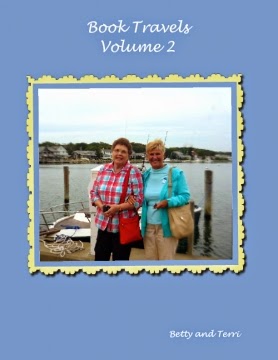
  I have made separate books for my book travels with my friend Terri.  We have made seven trips.  We have been to Nelson, British Columbia and twice to Banff, Alberta.  In the U.S. we have attended book experiences in South Carolina, Martha's Vineyard, and Arizona. When we went to Bath, England, with Bookwomen, we added trips to London and Paris.  Wonderful memories!  Journals keep them alive!
  
Memories can be captured in photos, but they don't tell the whole story.  There are many details and experiences that need to be told in story.  I love to pull every bit of pleasure from travelling. Reading and re-reading journals keeps the fun, excitement and appreciation going for years!

Monday, 9 February 2015

Personal Writing

   Two years ago, I met Ross Procter.  He was 85 and had just finished putting together some of his photos and poetry, hoping to get them published.   He asked me to edit the collection.  What a privilege!  And what a delight to find the finished copy in the mail a few months later.  He titled it "Memories and Musings" and that is exactly what it it.
   Ross is a fascinating man to begin with.  He was a farmer by trade but really a cowboy in his heart.
   His book is filled with love and adventure.  What a guy!  How extraordinary to find this combination of love and adventure- tough guy and loving family man.  Here is one of his poems:


Horses
I like the smell of a horse.
I like the feel of their nose.
I like the sway of the saddle,
As I ride down the dusty road.
The trot is a bouncy encounter.
I endure it because we are friends.
I guess I'm a lover of horses
And I sure hope this 'affair' never ends.
I first met a plow horse called "Barney"
That my Dad used to work in a team.
I've known "Bill", "Mike",
"Rawhide" and "Brownie",
And a bay we used to call "Queen".
"Buck" is a foal out of "Ginger"
With a quarter stud for a sire.
Between us we've learned to herd cattle,
But I know Buck could prove me a liar.
You see, I say we keep cattle for profit,
But he knows the real reason of course-
A cowboy's got to have cattle-
So he can ride herd with a horse.
Ross Procter, 1975

The book has lots of family photos with poems for his wife, children and grandchildren.  Also he has written philosophical articles on the death or sickness of a friend.  Lots of travel as well.
What a gift for his children and grandchildren, to be reminded that Ross was a cowboy with a tender heart.
We met Ross again this year.  Although he was on two canes and often needed a wheelchair, his spirit has not changed.  He still is the cowboy!

Friday, 6 February 2015

The Storied Life of A.J. Fikry

"A wonderful, moving, endearing story that will sing in your heart for a very, very long time".
That was the blurb on the cover.  And I was prepared to love this book.
  A book about a little girl growing up in a book store on a New England island with a cantankerous, widowed father.  Doesn't it sound wonderful?
  Recently published, it has received great reviews from other people and has been translated into many languages.
  Each chapter starts with a book review that the father writes to his daughter- books that he would like her to read some day.
  I was certain that I would love it, because of the book store atmosphere.  But I found the little girl unbelievable.  As a preschooler, she was thinking about the book "Caps for Sale" and deciding that the monkeys must represent something else, because monkeys wouldn't want hats.
  Oh, by the way, the little girl was left in Fikry's book store by the mother who then drowned herself.  Fikry's wife had recently died and Fikry was bereft.
  I also found it predictable.  There was a publishing house representative that visited the remote island and it was obvious that Fikry would fall in love with her.

  A little girl sitting on the floor, paging through the books.  What's not to love?
I wish that I had loved it more.

Monday, 2 February 2015

Poisonwood Bible


What an amazing week I have had!  After three fabulous days at Fern lodge in Orillia with the Drayton Theatre Travel Club, I came home to three days of book discussions.
On Thursday, I was discussing one of the Canada Reads books at a coffee shop.
On Friday I was discussing "Olive Kitteridge" at the library, and today- surprise!  Serendipity!
Out of the blue, a friend of my daughter asked to talk to me about "The Poisonwood Bible". 
I read this book in 2000, and it is the absolute best book that I have ever read!  My enthusiasm for it increases with time.  Nothing compares to it!
  A missionary family in the Congo is completely unprepared for African life: Nathan and Orleanna Price, Rachel (15), Leah and Adah (14) and Ruth May ( 5).
  The chapters are written in alternating voices of the children with a retrospective discourse by the mother at the beginning of each section. The father, Nathan, does not have a voice in the book.
  Nathan Price was arrogant and abusive and self-absorbed.  He  was on a 'mission' and would not be deterred.  He chopped down wild orchids and pulled out the native poisonwood tree to plant his demonstration garden.  This was symbolic of his lack of interest in African culture and African needs.
  This book is not derogatory to Christian mission, in my opinion, but a reminder that arrogance has no place there.

Orleanna Price: "I had washed up there on the riptide of my husband's confidence and the undertow of my children's needs".
"Riptide" and "undertow" are both strong currents in the water.
Isn't this a metaphor for the way many women spend their lives?  Torn between the desires of their husband and the needs of their children?
I have found this literary theme to be very fascinating.  Some of my favourite books have this theme:
"The Secret River" by Kate Grenville
"The Mosquito Coast" by Paul Theroux
"The Sea Captain's Wife" by Beth Powning

I greatly appreciated this opportunity to remember my great love for this novel.  The style of writing is delightful,  the characters are fascinating, the plot is riveting.
It is the best book that I have read in 15 years!

Friday, 30 January 2015

Olive Kitteridge

"Books are humanity in print".
(Barbara Tuchman- American author and historian)

This morning, I lead a discussion of "Olive Kitteridge" by Elizabeth Strout.

It was not written as most of the book club would like.  Rather than a direct narrative, it is composed of related short stories- or episodes.  But I found the book to be quite profound. Each story, centred around local characters in the town of Crosby, Maine, illuminates issues and situations that people face in life.
At the core, the book is about a hunger that each person has - for love, for connection, for relationship.  But that hunger can lead to disaster.  And so..
The book was too sad for some of the book club members and I was unable to convince them of the significance of the book.
With sixteen book club participants, the book only received a rating of 6.9 out of 10.
The book was granted a Pulitzer prize and has been made into an HBO mini series.
I love Elizabeth Strout's writing and enjoyed two other books that she has written: 


"Abide With Me" is about a minister in a small town in Maine.  Tyler Caskey is deeply grieving the death of his wife and is ineffective with his congregation and his young children.  Once again, there are serious issues of trying to hang on when your world falls apart.
It is a beautifully-written story with a great introduction, well-developed characters, and an interesting plot.  The ending was satisfying and I loved the book!


"Amy and Isabelle" is about a mother and daughter. Once again, the difficult issues of life are explored. 
Quote:
"There was all sorts of unhappiness in Shirley Falls that night.  If Isabelle Goodrow had been able to lift the roof off various houses and peer into their domestic depths she would have found an assortment of human miseries."
This was Elizabeth Strout's first novel and I loved the writing.
______________________________________________________
"We want to know, I think, what it is like to be another person, because somehow this helps us position our own self in the world.  What are we without this curiosity?" (Elizabeth Strout)


Friday, 23 January 2015

The Story of The Other Wise Man

This would have been a great story to read at Christmas, but my friend just loaned it to me.  And it is a powerful story for any time of year.
A very old story!  Written in 1895.
Short and thought-provoking.


The author, Henry Van Dyke, was born in 1852, graduated from Princeton Theological Seminary and taught English literature at Princeton for 25 years.
This book was published in 1895 and has been the subject of three operas, a play, a T.V. movie, a painting, a children's story and you can find it on YouTube.

The story is about Artaban, the fourth wise man who was following the signs in the sky, searching for the King that was born among the Jews.
He had sold everything he had, in order to prepare for the journey. But along the way, he stopped to help people in trouble and ended up using the treasure and missing the the caravan with the other wise men.  He continued searching for many years and ended up in Jerusalem just in time for the crucifixion of Jesus.
He had just saved a woman from being sold into slavery when he was struck on the head by a falling roof tile.  He had been feeling that he had wasted his life, since he did not accomplish the great dream of his life- to find the Christ.
But then he heard a voice say," Verily, I say unto thee, inasmuch as thou hast done it unto one of the least of these my brethren, thou has done it unto me".

There's a great moral to this little parable.
The author never felt like it was his story, didn't know where the idea came from.  He felt that it was a gift to him and now it is a gift to us.

3 more interesting things about VanDyke:
1.) He was a friend of Helen Keller, who wrote of his great kindness.  
2.) He said. "I'm not an optimist.  There's too much evil in the world and in me.  Nor am I a pessimist; there is too much good in the world and in God.  So I am just a meliorist, believing that He wills to make the world better, and trying to do my bit to help and wishing that it were more".
3.) VanDyke was a poet and I like this particular poem:


"Time is
Too slow for those who Wait,
Too swift for those who Fear,
Too long for those who Grieve,
Too short for those who Rejoice,
But for those who Love,
Time is not."

Monday, 19 January 2015

Paulo Coelho

Paulo Coehlo- what an interesting man!
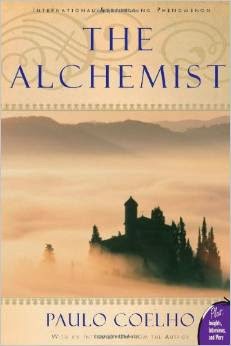
I had read his very famous book "The Alchemist", and copied many good quotes from the book.  It is a fable with the theme of following your heart.  Good little book!  In fact, it won the Guinness World Record for most translations by a living author.  Pretty good, eh?
My favourite quote: "The search for your dream is an encounter with God and eternity."

I also had read "Veronika Decides to Die".  Strange title, but I also enjoyed that book about a woman who spends time in a mental institute because she is 'different'.  I knew that Coehlo had written that book from his experience of a mental institute in his teens.  His parents sent him there because he would not follow the traditional path that they had set for him.  He escaped three times before he was finally released after three years.  He became a songwriter.  But the  government thought his lyrics were dangerous and he was arrested.
When he was 39, he walked the Road of Santiago de Compostela in Spain, where he had a spiritual awakening and began writing.  That had been his dream, and now he focussed on writing about 'following your dream'.
He is a United Nations Messenger of Peace.
And so..
I decided to read his latest book "Adultery".

Plot: Linda lives in Geneva, has everything she always wanted- devoted husband, healthy children, beautiful house, and a good job.  But she is empty.  When she runs into a former boyfriend from high school, she makes sexual advances immediately and attempts to destroy his wife so that she can be with him.  She is without a conscience as she makes herself constantly available for this man, even though she knows that he has no serious interest in her.

Smack dab in the middle of the book, there is a chapter that sounds like a sermon.  The topic is God's love and there is a reference from the Bible and an explanation of Paul's viewpoint on Faith, Love and Charity.  In the next chapter she is buying drugs to incriminate this man's wife. What is this author trying to say?

Linda is on a path of self-destruction and I was expecting a reason for this- some childhood trauma, perhaps.  But she said, "When I was a teenager, everything in my life went exactly as I planned. I was happy."
But now, she says, "There is a hole in my soul".  So she gives her time and energy to this man who is a politician.  She has no concerns about getting caught.  No guilt.

But this author is Paulo Coehlo.  I kept expecting something of great value, something insightful!
Then... on page 163, it turns into "Fifty Shades of Grey"- explicit, violent.
Let me say that Paulo cannot write for a woman in her thirties with two small children. I realize that many couples begin to feel that life is not fun anymore.  But women in that situation don't have time or opportunity for the constant sexual romps that Linda experienced. She made it her number one priority and charged right into her lover's office regardless of the fact that he didn't want her there- and she was supposed to be at her job.

Big disappointment!  No insights!  Just a story about adultery.  Perhaps the title should have warned me?


Friday, 16 January 2015

One More List

At this time of year, I am anxious to find out what will be happening on Canada Reads.
Here is the long list for this year:

1. Arrival City: The Final Migration and Our Next World (Doug Saunders)
2. Ru (Kim Thuy)
3. What We All Long For (Dionne Brand)
4. The Inconvenient Indian: A Curious Account of Native People in North America (Thomas King)
5. This Changes Everything: Capitalism vs. the Climate (Naomi Klein)
6. The Door is Open: A Memoir of a Soup Kitchen Volunteer (Bart Campbell)
7. Celia's Song (Lee Maracle)
8. Intolerable: A Memoir of Extremes (Kamal Al-Solaylee)
9. Bone and Bread (Saleema Nawaz)
10. When Everything Feels Like the Movies (Raziel Reid)
11. You Set Me on Fire (Mariko Tamaki)
12. For Today I Am A Boy (Kim Fu)
13. All My Puny Sorrows (Miriam Toews)
14. And the Birds Rained Down (Jocelyne Saucier)
15. Monkey Beach (Eden Robinson)

Wow!  I have only read one of these books, and I have heard of only three others.  Several are translations.
The theme this year: What is the one book to break barriers? 
"Books that can change perspectives, challenge stereotypes and illuminate issues"
Host: Wab Kinew
The panel and final five books will be revealed on January 20.
Fortunately, I have a group of friends that gather in a coffee shop to discuss each Canada Reads choice in depth.  So, I am very invested in the final decision.  It looks like there will be great discussions!  I am ready to start reading!


Friday, 9 January 2015

Nineteen Eighty-Four by George Orwell

I just finished reading "1984" by George Orwell and it was a challenge- at times rather fascinating but at times deadly boring.
One of the book clubs that I attend, chooses 6 classics a year, as well as 6 contemporary novels.  I have belonged for 16 years, so I have read 96 classics with this group.
I have to admit that many of the classics are challenging and there are other books that I would prefer to read.  However, it is a great discipline and I appreciate this wide sweep of literature.

Imagine my surprise when I checked on another blog that I enjoy, called "Giraffe Dreams".
The focus of that blog entry is Hans Litten- the man who stood up to Hitler.
Carol posted a poem called "Thoughts Are Free".
Check it out here.
Now I am ashamed to complain about reading a difficult book that should have reminded me of the importance of our freedom- to act, to think, to be! 
Carol says, "Hitler can burn books and imprison intellectuals, but thoughts are free.  Never stop reading".


                                                           Unfortunately, in Orwell's book, thoughts were not free.  It is a dystopian novel where Big Brother was watching and the 'thought police' were everywhere.

Thanks, Carol, for your blog entry that reminds us to be grateful for our freedom.  


Thursday, 8 January 2015

New Year Challenges

Happy New Year!
Here's an interesting challenge!
It comes from a blog called "Bringing Up Burns".  
Erin Burns is a mother of three very young children and her blog is eclectic!  It includes recipes, music, her own version of slang, Bible quotes, T.V. shows, and books.  This quote shows just how eclectic she is: "I love Jesus Christ, Barack Obama, and Miley Cyrus."
Erin read 104 books in 2014 and she throws out this challenge to get people reading and talking about their choices.  She is on many forms of social media and has a very large following!

26 books in 2015
1. A book you own but haven't read
2. A book that was made into a movie
3. A book you pick solely because of the cover
4. A book your friend loves
5. A book published this year
6. A book by an author you've never read before
7. A book by an author you love
8. A book at the bottom of your 'to be read' pile
9. A book with a colour in the title
10. A book set somewhere you've always wanted to visit
11. A book you started but never finished
12. A book with a lion, a witch or a wardrobe
13. A book with a female heroine
14. A book set in the summer
15. A book of poems
16. A book you learned about because of this challenge
17. A book that will make you smarter
18. A book with a blue cover
19. A book you were supposed to read in school but didn't
20. A book 'everyone' but you has read
21. A book with a great first line
22. A book with pictures
23. A book from the library
24. A book you loved...read it again!
25. A book that is more than 10 years old
26. A book based on a true story

I have seen many challenges similar to this, with suggestions such as:
Read 26 books with titles starting with each letter of the alphabet.
Read 10 books with a colour in the title.

Goodreads has a challenge every year.  Readers choose how many books they plan to read for the year.  So far this year, there are 478,599 participants.
It is great fun to look ahead to a new year of reading!


Monday, 5 January 2015

Another list

How to decide what to read?
I make my choices either from my book clubs or other recommendations.  Those recommendations can come from individuals- like my friend Penny.  She recommends: "The Goldfinch", "Belle Cora", "The Signature of All Things" and "The Notorious Woman".
I also get lots of ideas from a periodical called "Bookwomen".
My friend Terri and I share a subscription and we find many great recommendations in Glenda Martin's column.  We have travelled with Bookwomen and Glenda is a fabulous discussion leader.  She knows her books!
I found this list of books in the most recent edition.
Top 20 most influential books by women selected by readers in England.
1. To Kill a Mockingbird (Harper Lee)
2. The Handmaid's Tale (Margaret Atwood)
3. Jane Eyre (Charlotte Bronte)
4. Harry Potter (J.K.Rowling)
5. Wuthering Heights (Emily Bronte)
6. Pride and Prejudice (Jane Austen)
7. Rebecca (Daphne du Maurier)
8. Little Women (Louisa May Alcott)
9. The Secret History (Donna Tartt)
10. I Capture the Castle (Dodie Smith)
11. The Bell Jar (Sylvia Plath)
12. Beloved (Toni Morrison)
13. Gone with the Wind (Margaret Mitchell)
14. We Need to Talk about Kevin (Lionel Shriver)
15. The Time Traveler's Wife (Audrey Niffenegger)
16. Middlemarch (George Eliot)
17. I Know Why the Caged Bird Sings (Maya Angelou)
18. The Golden Notebook (Doris Lessing)
19. The Color Purple (Alice Walker)
20. The Women's Room (Marilyn French)

Lots of wonderful reading in this list!  I have read half of them. 


Saturday, 3 January 2015

"The Book Thief" by Markus Zusak


My granddaughter Erika is reading "The Book Thief" and thinks it is the best book that she has read because the writing is so excellent.  Set in Germany during the Second World War, this story is about a girl whose family decides to hide a Jewish man in their basement.
One problem that Erika saw with the book is how the author tells what is going to happen. That spoils the story for her.  But she still loves the book.
Death is the narrator and here is a quote:
"Of course, I'm being rude.  I'm spoiling the ending, not only of the entire book, but of this particular piece of it.  I have given you two events in advance, because I don't have much interest in building mystery.  Mystery bores me.  It chores me.  I know what happens and so do you."
Erika loves the characters and the relationships in the book.  She has been reading this book during her family's skiing holiday.  Now she is heading back to school at Oakland University in Michigan.

Thursday, 1 January 2015

The Best of 2014

Have you noticed that some books are really enjoyable while you are reading them, but you forget them very quickly?  Other books really stay with you even though you may not have appreciated them as much while reading them.
I have read 70 books in 2014.  My favourite was:


Other great books that I read in 2014:
Most interesting non-fiction: "The Woman Who Can't Forget" by Jill Price
Most fascinating and challenging fiction: "The Signature of All Things" by Elizabeth Gilbert

Also great reads:
"A Young Wife" by Pam Lewis
"The Orchard" by Theresa Weir
"Wild" by Cheryl Strayed
"The Purchase" by Linda Spalding
"Caleb's Crossing" by Geraldine Brooks
"The Invention of Wings" by Sue Monk Kidd

Happy New Year!
Happy Reading!


Monday, 22 December 2014

Yesterday I read a book.  Not a novel, but a musical score that was written in 1741 by George Frederic Handel.
I had been taking advantage of every musical concert that I could attend this Christmas season.  My daughter discovered this opportunity:

Messiah Sing-A-Long offers a shorter version of Handel’s popular oratorio and provides opportunities for singers of all ages and talents to sing along with the 
choir which will be seated amongst the audience.

We arrived just in time to be handed a book of music and given the last seats in the front section of a large, packed church, where the visitors were seated with the choir.  I was in shock as the music started. I opened the book and tried to find my line of music.  As the orchestra began playing, I felt like I had been dropped into a rabbit hole and was in another universe. "Betty in Wonderland".  I had not yet adjusted to the cathedral-like atmosphere, decorated beautifully for Christmas.  I had never seen this music.  What was I doing here????
Thankfully, there were two arias before we needed to start singing.  I thought I was familiar with some of the music, but WOW!  The first chorus number was "And the glory of the Lord".  I was swept away by all the beautiful voices around me.  I kept my eye on the members of the chamber choir that were sitting in front of me.  I may have squeaked out a note or two because that is a very familiar piece, but further chorus pieces were unfamiliar and hard to follow.  Since the church was full and the voices were loud and the orchestra was amazing, I could just stand in awe whenever I was swept away.
I waffled between complete amazement and disbelief.  I almost laughed at the absurdity of the situation!  One of the soloists added a dramatic flair as he sang his aria and I could hardly keep from giggling.  This was bizarre! 
Two and a half hours later, I was excited as we approached "The Hallelujah Chorus".  And then, I really knew I was in another universe!  The trumpets started as well as the drums!   I was swept away by all the spectacular sounds, but determined to be a part of that amazing piece of music!  I know I sang "King of Kings and Lord of Lords", but the rest of the time I was out of my body.  Amazing!

                                     Merry Christmas!


Monday, 15 December 2014

The Signature of All Things P.S.

Two additional thoughts about "The Signature of All Things":
The title:  Brilliant!  I have complained about thoughtless titles.  But, who came up with this title?  I'm not sure that it is original, but it is brilliant!
The covers are both very fitting.
The afterglow: I am finding it difficult to get involved with another book. I find myself still ruminating.  And I am reminded of this quote from "The Thirteenth Tale" by Diane Setterfield: "Do you know the feeling when you start reading a new book before the membrane of the last one has had time to close behind you?"

Saturday, 13 December 2014

The Signature of All things

What can I say about this novel?
It's long.  I listened to it on cd's.  It took 21.5 hours.
And it will take me longer to digest it.  
Elizabeth Gilbert has taken on such a complex subject.  The best description I have read is that it is a "botanical odyssey". That really describes it well- a long series of wanderings or adventures, especially when filled with notable experiences, hardships, etc.  
Here is the plot in a sentence: Alma Whittaker, born in 1800, grows up with a fascination for botany and it leads her into the mysteries of evolution.
Simple plot but so complex!
A fellow reader that I respect has read it three times and says this: "I totally marvel that a 48-year-old woman explores such deep questions in her novel."
Now I feel guilty about complaining about the length!
Really, it is about the origins of the earth and everything in it.  Now how profound is that?

And I really appreciate history put into a fictional form.  Much of this novel is based on fact.  The settings are actual places- Kew Royal Botanical Gardens in London and the Hortus Botanical Garden in Amsterdam.  
Some of the characters are real- certainly Darwin, but also Alfred Russel Wallace, who was a friend and follower of Darwin.  Alma never met Darwin, but she did have a wonderful encounter with Alfred when he read Alma's research and realized the "extraordinary simultaneity"- three people coming to the same conclusions about the 'origin of the species'- Alma, Wallace, and Darwin.  But Darwin was first!
And so, it is about the theory of natural selection. But it doesn't stop there.  Alma knew that there was something missing from her research- something to account for our unique human consciousness.  And so the book ends with Alma (at 82), discussing with Alfred Wallace, the mystery that goes beyond science.  Wow!  

Monday, 8 December 2014

Inscriptions


We did not have money to buy books when I was a child, but we received gifts of books, mostly from the Sunday School for good attendance.  I loved these books and clearly remember reading them.
In my pile of 'oldies', there are books presented to various members of my family.  The oldest book is from 1909- a gift to my aunt at age 7.
There is no copyright date on that book. 

"Baby Kangaroo and Lilly Lamb" was given to me at age 5.  There is no copyright date.  It is adorable with coloured photos and black and white photos.  It is part of a series of baby animal stories.  What is better for young children?  Now or then?


Books with inscriptions:


Friday, 5 December 2014

More Old Books


This collection of books is also worrisome.  There probably is no point in donating them.  Who would want to read them now?  We are bombarded by new, exciting novels every day.  Also, they are yellowed and tattered.  I know my children and grandchildren would not appreciated having them moved to their homes.
So I have decided to re-read them, record and journal about them and then dispose of them.  There is a season for everything.  And their season is passed.


I decided to start with books by Grace Livingston Hill.  I remember reading her books in my teens.  And when I began to volunteer with the library at the Mennonite nursing home, these books were popular with the ladies there.Grace Livingston Hill was born in 1864.  She wrote over 100 novels and numerous short stories of  Christian fiction. Her characters were usually young strong Christian women.  Perhaps that is why they were popular gifts from Sunday School. Rereading them for the first time in many years, I can understand the appeal of a black-and-
white world where faith was strong.

"Coming Through the Rye"  c 1926
Romayne was one of those young, strong, Christian women. Her mother had died and she lived with her father and brother.  When she arrived home one day, she found Evan Sherwood and his fellow police officers waiting to arrest her father and brother who were involved in bootlegging.   She adamantly denied this and was rude to Evan.  When they showed her the proof, her father arrived home, collapsed and eventually died.  Evan was very protective and supportive of Romayne as she was in danger from her brother's friends.
In fact, Evan offered to marry Romayne and they lived happily ever after!

Monday, 1 December 2014

Old Books

What can you do with old books?  While re-organizing my living room, I cleaned out the book shelves.  And I found some old books.
Just look at this wonderful set of World Book Encyclopedia from 1967.
They are commemorating the centennial of Canadian Confederation.
Very special and very important to our family.
Our children were too young to use them in 1967, but we thought they were a wonderful investment.  And they were!


Now we are finding it hard to get rid of them.  They certainly are not needed any more.  But they have been important to our children and grandchildren.  They have become almost a part of the family.
At my age, anything that you part with makes a sad occasion.  The memories swarm back.
And parting with the encyclopedia was the beginning of weeding the book shelves.