Saturday, 8 February 2014

Another man Who Loves Jane Austen

Yesterday we celebrated Alan's birthday.  When I looked at the celebration pictures, I thought of my last blog -"The Man who Loved Jane Austen" and I realized that I needed to add Alan to my blog.
Alan is another man who loves Jane Austen.  And during dinner, he initiated a conversation about the reasons that Jane Austen is still so popular.  What a great way to spend time with friends! Discussing literature - Jane Austen in particular.
Alan's 88th birthday
Alan's favourite Jane Austen book is "Mansfield Park".
I'm sure there are lots of 'men who love Jane Austen'.
The birthday bash


Wednesday, 5 February 2014

What's John reading?


"The Man who Loved Jane Austen" by Sally Smith O'Rourke

A story of time travel, mystery and love.

Monday, 3 February 2014

Books that change your life

Canada Reads is following the theme of "Books that can change the nation".
Check here for the books that are being considered.
Can books really change the nation?  The change would have to come one person at a time.  So what can really change a person?
   This morning I read this on A.Word.A.Day:

   It is nearly impossible to say how much Harry Potter has changed my life and made me the person I am today. The Harry Potter series was my childhood and its life lessons helped me grow. Whenever I have been in a bad mood, Harry Potter has been there for me. When I didn't have friends at school, I didn't feel so bad because I knew Harry, Ron, Hermione, and everyone else was just a turn of a page away.  In these books, Headmaster Albus Dumbledore stands out for me. He says many wise words that have stayed with me. One time he says to Harry, "It does not do to dwell on dreams and forget to live." Dumbledore is telling Harry not to dwell on the past, and to live out his life to the best of his ability even though his parents aren't with him anymore. It made me feel as if he was saying, if you want something you have to go and get it, rather than sit around and dream, waiting for something to happen. Also, don't sit around worrying about the past and things that you can't change.

I loved this comment because childhood is the greatest time to read a book that will help to give you confidence and support. "Harry Potter" was condemned by many people.  Some parents didn't want their children reading it because of the dark themes.  Rowling states that the main theme is death.  But there are other themes that children pick up on.  And perhaps with the theme of death, children can learn how to live.

But how is Canada Reads going to convince us that the books they have chosen can 'change the nation'?

Friday, 31 January 2014

angst about fathers


   After the angst of "The Dinner", I was delighted to read about a good father.The delightful Leo Buscaglia has written about his father.
   Leo Buscaglia was a university professor known for his courses on love.  This is a lovely, short story about his father, who was the son of a poor farmer and went to work in a factory while in grade five.  The world became his school.  Since he was unable to get an education, he was determined that his children would be educated.  He insisted that every day each child learn one new thing.  When dinner was over, Papa pushed back his chair and asked what each child had learned that day.
"By looking at us, listening to us, hearing us, respecting our opinions, affirming our value, giving us a sense of dignity, he was unquestionably our most influential teacher".


   Of course, this book feeds into my angst about who gets a good father and who doesn't!


Wednesday, 29 January 2014

The Sins of the Father


"The Dinner" by Herman Koch is rather popular right now and it reminds me that I am really 'out of touch'.  I went along with the  pace of the book even though it was frustrating.
  I knew that the author had something to say, but was taking a very long time to say it.  Half-way through the book, it is apparent that the author is trying to set up a moral dilemma for parents : "How far would you go to protect your child?"
   I love dilemmas, but by the end of the book, I was disturbed to think that this situation was at all debatable. We really have lost our moral compass when we cover up for a son who is torturing and killing homeless people.
  

The Plot
 Two brothers each have a son involved in torture and killing.  The whole book is about the meal the brothers and their wives share to 'talk about the situation'.
  One brother, Serge, is about to run for prime minister  and he is portrayed as narcissistic and arrogant.  The other brother, Paul, is the narrator, and appears fairly tolerable at the beginning.  But, by the end, you realize that Paul is psychologically unstable- has beat up the school principal, threatened the store keeper, and attacked his brother with a hot pan.
  
  Serge, the brother that was described as an egocentric buffoon, ended up giving up his chance to be prime minister.  But the 'good' brother, Paul, just smiled about the 'antics'.  He believed that secrets don't get in the way of happiness- and happiness was certainly what he was fixated on. 
  But Paul definitely had psychological problems.  In several places it mentions how a damp film slid down over his eyes, or that he heard something snap, or 'something happened', also he seems to black out- there is a gap in time.

But the mother- what about the mother???
  What surprised me is that Paul's wife schemed to cover up the crimes.  When speaking about the 15-year-old boys she said, "We don't have the right to take away their childhood, simply because, according to our norms, as adults, it's a crime you should have to pay for, for the rest of your life." 

  This novel takes place in Amsterdam.  Does that make a difference?  Is their moral compass different?  Would this really be a dilemma?

  The author certainly manipulates the reader.  In some places he says, I won't tell you that".  He feeds the information to the reader as he wills and it certainly does change the whole story- all over the courses of a "dinner'.  Does that make a good read?

  And so, I see the theme of 'the sins of the father are visited on the children'. And I am aghast that it is debatable whether the parents should cover up this type of criminal behaviour in a child.


  But- at the end, the author makes a point of exposing hospital records from the birth of Paul's son and in the amniotic fluid test that was given to Paul's wife, it was noted "decision parents"(in other words, the decision was made by the parent).  Paul did not know anything about that, so I wonder if he just discovered (on the third last page) that he was not really the father.  The author makes a point that his son looked like him, so perhaps he really is his dreaded brother's son?


Wednesday, 22 January 2014

Personal Libraries

Noreen

A book club friend was lending me a book from her personal library.  Noreen is a kind, suppportive and intuitive friend.  She offers advice, books or prayers when she senses they are needed.  After a book club discussion that focused on man's inhumanity to man, she recommended a book by Leo Buscaglia.  I had quite forgotten that author.  In fact, he died in 1998.  But Noreen knows that I dislike focusing on violence.  And I appreciated being reminded of this wacky, wonderful author/lecturer.  I searched out my copy of "Living, Loving and Learning" when I got home.  And I listened to his lectures on the internet.  A wonderful return for me to the more gentle aspects of life.

       
Leo Buscaglia


While searching through Noreen's personal library, I mentioned that you can learn a lot about a person by looking at their personal library.  She agreed. She has a large collection.  
  Once when she had overnight guests, she positioned a stack of books beside the bedside lamp of each guest with books of a particular interest to that guest.  What a personal, thoughtful idea.
  She has given many, many boxes of books, written for children and adolescents, to the Home Schooling Association.  She also was delighted when the local school accepted her offer of books.
  Over the years, Noreen has had dozens of biographies because she loves learning about individuals and how they were motivated in life. 
  She has thinned out her collection of cook books but still has more than needed.
  Since she was in the nursing field, Noreen developed a large collection of nursing books and has donated them to several long term care facilities.  Two of those institutions had no reference books at all and Noreen felt that they were important for quick reference and could make better and safer patient care.
  Books on religion, philosophy and history have gone to the church library.
  These donations make it less painful to part with important books.
  Noreen's personal library is certainly a reflection of her many interests and her generous spirit.


Friday, 17 January 2014

Canada Reads 2014


  We had our first mini-debate with five women who are Canada Reads' fans.  We discussed "Annabel" by Kathleen Winter. I have already mentioned this book on my blog.  But preparing for the discussion, I realized that the book was even better than I had originally thought.
  Of the five of us, I was probably the most enthused by this book.  After finishing all five books, I definitely think it is the best of the five.  It has a theme of developing self-esteem and finding your way in the world.  And the characters are fascinating.  It is the only book of the five that I would recommend to anyone.  It certainly reflects life's challenges, but it shows the possibility of 'rising above'- finding joy in the midst of challenges and confusion.


  Well, our second discussion was focused on "Cockroach" by Rawi Hage.
The author admits that it is 'a hard, uncompromising book'.  Samantha Bee, who will be defending the book says that it is 'painful and dark'.
The title comes from the unnamed protagonist who "felt the need to strip the world and exist underneath".
   I see no purpose in producing books that are hopeless throughout.
Perhaps the worst for me was the violence of the male characters.

I was reminded of "The Slap" by Christos Tsiolkas.  I read that book for a book discussion weekend in Nelson, B.C.  It is a novel filled with violence, drugs, alcohol, and abuse.  The men were totally misogynistic and the teenagers were so out of control.  After an evening of discussing that book, I had nightmares where I was trying to save my grandchildren.  I woke up very disturbed.  Some people believed that the book was a reflection of society and I do not want my grandchildren to grow up in that type of world.

  The next book in my 'reading agenda' is, of all things "Emma" by Jane Austen.  Wow!  What a difference!  The men in "Emma" are cultured, polite and mannerly in the extreme.  Of course it was written in1815 and Austen only chose to write about the gentility.  But I am finding this book so refreshing!  Bring on "Emma"!
                                                                   

Thursday, 2 January 2014

Terri's Picks

Terri in Nelson, British Columbia


My friend Terri is a great reader.  We have travelled to many book events together- in England, British Columbia and the U.S.  Twice we have gone to Banff for the Banff Book Weekend.  We share book talk- a lot!  So I am delighted that she gave me a run-down of her reading for the last year.

From Terri:
I read 54 books in 2013 and I will attempt to tell you about them; some that I loved, some that I only liked and even some that I did not enjoy. 

       The first book that I thought was very thought provoking and a very good read was "The Round House" by Louise Erdrich. Geraldine who lives on an Ojibway reservation is raped. She will not divulge what happened and who the man is. She will not even speak to her son and husband and stays in her room in bed for months. Her son Joe is frustrated with the investigation and takes matters into his own hands.


  One of the books that I did not enjoy was "February" by Lisa Moore, the 2012 Canada Reads winner. I found the style of writing difficult to follow and the story disjointed. The sinking of the "Ocean Ranger" and the loss of so many lives and the loss of a husband is very sad, but I felt the story could have been told in a more interesting way. BUT I did enjoy her recent novel titled "Caught". Unfortunately the title gives the story away, but the writing was superior to "February", the characters were unbelievably simple minded and kept me entertained.

Richard Wagamese is the author of two gems that I read, "Iron Horse" and "Ragged Company". In "Iron Horse" a young Aboriginal boy is taken from his home and sent to a residential school. A priest teaches him to play hockey. He practices long hours and becomes a very good hockey player. Later when he escapes from the school, again he turns to hockey but finds racism and cultural displacement. "Ragged Company" is, in my mind, a brilliant title. Some people I know, are attracted to book covers, while I am fascinated with book titles! Four homeless people become friends, and during a cold spell find warmth in a movie theater. They find they love movies and continue to frequent them. One of the men finds a lottery ticket for $13,000,000.00 and lives are changed. The stories of the four people are full of emotion, some humour and I thought about this book long after I had read it. The mark of a good story teller.

One of the finest gems I found was "The End of Your Life Book Club" by Will Schwalbe. Having a medical background, I did not find the book morbid, as some of my friends had suggested. I loved the mini-book reviews - in fact I prefer them to long reviews because I want to find out about the book by reading it. I also was touched by the work Mary Anne did with refugees and establishing libraries in Afghanistan. I absolutely loved this book. "Tuesdays With Morrie" by Mitch Albom is also a book I re-read constantly. I keep it in the car and when I have to wait at an appointment, I take it with me. These people are inspiring!


I read 3 books by Lauren B. Davis who in my opinion is very underrated. "The Empty Room" is an account of the last day of an alcoholic woman before she hits bottom and reaches out for help. It is very moving and visceral. The next book was "Our Daily Bread" which is based on a true story.There are those people up on the mountain where unspeakable events are taking place and then there are the people in the town below, who know, but look the other way. The story unfolds and the last part of the book is filled with tension.
Lauren B. Davis
Then of course I had to read her fourth book "The Radiant City". This book takes place in the not- so- touristy parts of Paris where the cast of characters include a war correspondent suffering from the violence of war, the people he befriends and immigrants who settle in Paris and own a café. The first book I read by Lauren a few years ago was "The Stubborn Season". It takes place during the Depression. A young girl is trying to find her way through life with a mother who suffers from depression and a pharmacist father who drinks.  Lauren B. Davis is a great writer. Her writing is serious, with great attention to detail.

Philip Roth
"Indignation" by Philip Roth was the surprise of the year. I couldn't put it down. A young Jewish boy is so over-protected by his father that he chooses to go to a college far from home. It seems that wherever he goes there are dilemmas and the choices he makes just compound his problems. It is a very tense novel with a quick end! I loved it. I have read other books by Roth and he is a brilliant writer.


I read "The Lizard Cage" by Karen Connelly because it was one of the books mentioned in "End of Your Life Book Club". It is hard to describe in a few sentences but it is an amazing book. Hard to read sometimes as it takes place in a political prison in Burma, now Myanmar. A young boy is sentenced to 20 years in solitary for singing songs against the ruling dictator. The interactions in the prison revolve around the hierarchy of jailers and prisoners. It is a remarkable story told in great accuracy and detail. I learned much about the human spirit from this book. I quote from a book review   " Connelly's fine novel shows us the kind of suffering that newspapers can't communicate and non-fiction rarely reaches". In the end two prisoners are freed, each in a different way.

One of the most delightful books I read in 2013 was "The Art of Racing in the Rain" by Garth Stein. Told through the eyes of a dog who thinks like a human, it is sometimes funny, sad and even heartbreaking. The moral of the story is that one can navigate the twists and turns of life, like a race car driver does when racing in the rain. I really loved this book.

I will end with "Dying for Sex" by Lynn Albrecht. Lynn is a social worker at St. Mary's hospital where I volunteer in the Medical Library. We have a book club in the library and felt we needed to read and review this book. The main plot involves a murder of a nurse in a Retirement Home but there are so many other story lines and characters that I could hardly keep track of them all. There is a lot of dialogue which made the book hard to read. There are octogenarians, sex clubs, a catering business, a boy in a rock band with a bus, a detective, a wanna-be love story, and I can't remember what else. I give Lynn credit for writing a book but I would not recommend it.


   Sorry,but I had to add this book, "Travelling to Infinity" by Jane Hawking. I found it most interesting, from the point of view that things aren't always as they appear. I was quite surprised at some of the details that Jane brings out in her book. Life was not easy with Stephen Hawking, physically, emotionally and financially in the early days. He had the symptoms of the motor neuron disease when they were married and it only got worse with time. He was proud, fiercely independent, and showed no self pity. Jane was involved in his care 24/7 along with raising their 3 children, helping with the finances and trying to further her education. The book is very detailed and a long read, but worthwhile.


Thank you, Terri, for a very fascinating look at your reading choices in 2013!  Happy New Year!

Tuesday, 31 December 2013

Happy New Year!

At the end of the year, it is always fun to review the books that have been read during the year.  I have been keeping records since 2002. And I have read between 45 and 75 books each year since then.  This year I am right in the middle with 60 books read.
What was my favourite?  No question: "Indian Horse" by Richard Wagamese.
Fellow reader, Bonnie, also reports that "Indian Horse" is her favourite because of the beautiful writing. She was shocked by the ending.
Fellow reader Gayle, enjoyed Richard Wagamese's "Ragged Company", but her favourite of the year is "The Guernsey Literary and Potato Peel Pie Society". She loved the format- correspondence letters, and the setting- the Channel Island of Guernsey.  She had heard about Guernsey from her grandfather but learned more while reading this book.  Gayle loves to learn something from her books. Her runners-up are: "Blessings", "How to Talk to a Widower" and "Downhill Chance".
I love to hear about the books that other readers enjoy.
I have "Downhill Chance" on my bedside table, waiting to be read.  I love Donna Morrissey and will try harder to get to that book soon.

Happy New Year!

More on "Natural Order"


I have been thinking about this book and realizing that the writing is more extraordinary than I had first realized.  I knew that the characters were magnetic and the language was delightful.  But, on further thought, I ponder how well the plot was developed.  Actually there were stories of three gay men from three different generations.  What a powerful way to show the development of thinking in respect to homosexuality.  But this was accomplished by switching back and forth in time in a seemingly 'natural order'.  In retrospect, I realize how amazing this was.  The narrative just flowed without appearing forced.
Also, I came to realize how much I love a satisfying ending.  For me, that means that people work through the issues that were challenging in their lives.  Oprah called this an 'aha' moment.  I love a big 'aha' moment, when everything starts to make sense.  And, often, that only happens years after the fact.
It was so interesting to see how that 'aha' moment was achieved.  It took a number of circumstances to occur for Joyce Sparks to finally understand her son.


                                               Brian's comments on this novel:


The book tells the story of a senior woman named Joyce Sparks coming to terms with the death of her adult son. It’s about the mistakes we make in the name of love and the second chances that sometimes shine a light in our darkest moments.

The novel came about because I wanted to capture a character in the final years of life. What would she think looking back on her past? What did she think of her life now? What were the things she’d do differently if she were given the opportunity? Out of that curiosity, Joyce Sparks was born.
Brian Francis

Brian Francis (born 1971) is a Canadian writer. His 2004 novel Fruit was selected for inclusion in the 2009 edition of Canada Reads, where it was championed by novelist and CBC Radio One personality Jen Sookfong Lee. It finished the competition as the runner-up, making the last vote against the eventual winner, Lawrence Hill's The Book of Negroes.
Brian lives inToronto and has a cooking blog "Coker Cooking".


Monday, 30 December 2013

A Mother's Challenge

How does a mother handle a child that is different?
I just read two books where the mothers discovered that their sons were more interested in girlish play- dolls, cooking.  They both were not only uncomfortable with that, but felt the need to hide it from the fathers.  In one book, the child was a hermaphrodite, in the other book the boy was gay.
Both books were fascinating. I loved the characters, writing, plot and setting.  One was in small town Ontario and the other was in Labrador.  They both were emotional.  One had a more satisfying ending for me.


Saturday, 21 December 2013

How does it taste?


In a blog called "Zen Habits", Leo Babauta promotes his Sea Change program, which is about forming good habits.  One of the habits that he is promoting is reading.  For $10.00 a month, you can register for his approach.  I have not done that, but in his list of favourite books, I saw the title:
"The Particular Sadness of Lemon Cake" by Aimee Bender (c2010)
I knew this would be a take-off on "Like Water for Chocolate" by Laura Esquivel (c1992), which is a great book with such a novel premise.  Love books like that!  So I had to read this unusual title.


The Particular Sadness of Lemon Cake


In this novel, Rose, at nine, discovers that she can taste her mother's emotions in the cake that she baked.  She knows everything that is not being spoken of in the house- mostly her mother's affair.  This is similar to "Like Water for Chocolate" and I enjoy that type of magical realism.  However, Rose can also tell where the food was grown, sometimes as specific as the actual farm and whether it is organic.  Interesting premise, but a book needs more than a good idea.  It needs fascinating characters and a plot.  The mother, father, sister and brother never communicate and all seem severely depressed.  The plot consists of being concerned (or not) about the brother's disappearance.  This is really magical realism- he turns into furniture!  Sometimes he is a chair or a table.  You also discover that the grandfather had been able to smell emotions, so he had to cover his face in public to avoid the onslaught of emotions.


Like Water for Chocolate


This book is one-of-a-kind.  I found it extremely entertaining and read it twice.  It is a combination tall tale/ fairy tale/ Mexican cookbook/ home-remedy handbook.
It takes place on a ranch on the border of Mexico during the Mexican Revolution.
Mama Elena passes down the family decision that the youngest daughter may not marry but must care for her mother.  So when Tita, her youngest daughter, falls in love with Pedro, Mama Elena says that Tita is not available but Rosaura is and they marry.

Written from the perspective of Tita's grand niece, whose mother (Esperanza) and father (Alex) returned from their honeymoon to find the ranch covered in ash- cookbook intact, telling in each of its recipes this story of a love interred.
Like Water for Chocolate: being on the verge of boiling over.

Sunday, 15 December 2013

Canada Reads 2014


I am always excited by Canada Reads.  
I love a good, intelligent debate over books. 
And this year, I even have an opportunity to have mini-debates with some friends before the 'big debate' begins.
There is a new twist this year!  It really got me excited. Readers were challenged to nominate a book 'that could change the nation...or even the world'.  What a huge challenge!
Thousands of nominations poured in from across the country.  The top 40 books were announced along with a challenge to vote for your favourite.  This brought the list to 10, and then the panelists made their picks. So we are reading five books and trying to decide which book could change the nation.  Sounds fabulous, eh?

Well....I have read three of the picks and, to put it gently, I cannot imagine how the panel are going to argue that these books could 'change the nation'.

I found the books last year much more interesting and was really passionate about one.  It definitely could 'change the nation', but was not nominated this year because it had already been included last year.

Check my blog from last year by clicking on this:  Canada Reads 2013

Her are the books for this year:
1.) Half-blood Blues           -supported by Donovan Bailey
2.) Annabel                        - supported by Sarah Gadon
3.) The Orenda                  - supported by Wab Kinew
4.) Cockroach                    - supported by Samantha Bee
5.) The Year of the Flood  - supported by Stephen Lewis

I have a strong feeling about which book SHOULD win though I haven't read it yet.  Hint, hint, it is the second in a series of three, written by a very famous Canadian author.  But, since I was so disappointed last year, I will wait and see.....

Tuesday, 10 December 2013

Caleb's Crossing


  Isn't this a beautiful cover?
  This novel begins on Martha's Vineyard in1660.
Because I loved "The Scarlet Letter", I thought this book would also be interesting.
The language was a little challenging, but attempted to take you back to those days.

     Inspiration for the story (actual fact):
In 1665, a young man from Martha's Vineyard
 became the first Native American to graduate from Harvard College. 

  Although the novel is the story of Caleb, the son of a native chief, it is told through the eyes of Bethia, the daughter of a minister who hopes to convert the native population to Christianity.  She forms a clandestine friendship with Caleb and eventually follows him to Harvard, soaking up as much learning as she can while working as an indentured servant to the schoolmaster.  And this learning includes Latin, Greek, and Hebrew!  And she absorbs this while working in the adjoining buttery and eavesdropping!  A little unbelievable?

  I appreciated the view of the Puritan life, although there were many words that needed to be looked up- words that are not in use any more.  I did, though, enjoy the way they spoke.  And I enjoyed Bethia's character, even though it may be a little far-fetched.  While raised strictly Puritan, she had a great hunger for knowledge and a spiritual dilemma, as well. 

   Historical figures were mentioned in the novel.  Anne Hutchison was one.  She was the mother of 15, whose religious convictions were at odds with the Puritan church.  She had a lot of followers, but in 1643, she was massacred along with 14 of her children.  She is now honored in Massachusetts as a "courageous exponent of civil liberty and religious toleration".

   With the background of the Puritan, rigid, religious beliefs, you get glimpses of human connections that surmount the differences.  This is the kind of book that I love.  There are examples of extreme rigidity, but also complete acceptance and compassion for everyone.

  The title "Caleb's Crossing" is poignant.  Caleb crossed into the Puritan world- but was he really crossing, or just taking advantage of the other world?

  The combination of fact and fiction always interests me and I wondered about the books that would be available.  I discovered that the Puritans brought a printing press with them in 1638, where they printed religious texts.  One of them was a hymn book.  "The Bay Psalm Book" had about 300 pages and lots of errors, with words only - no music.  There were 1700 copies printed.  Only 11 copies remain today.  One of these copies was just auctioned at Sotheby's for 14.2 million dollars!

I have read two other books by Geraldine Brooks:
Geraldine was born in Australia, now living on Martha's Vineyard.  
"Nine Parts of Desire" is a disturbing book about women in the Middle East.  The title comes from a quote by Muhammad's son-in-law: "Almighty God created sexual desire in ten parts; then he gave nine parts to women and one to man."
It actually appears that men feel they cannot control themselves around women and so the women must not show any skin, go out in public, drive a car, speak in public, etc. etc.  Disturbing!
"March" is a really interesting book using a character in Louisa May Alcott's "Little Women".  The father, Mr. March has gone to war- actually he is a chaplain in the civil war, but has spiritual torment about what he experiences there.  This book won the Pulitzer Prize in 2006.


Thursday, 5 December 2013

Maeve Binchy


Maeve Binchy

1940 – 2012

Maeve Binchy, was best known for her humorous take on small-town life in Ireland, 
her descriptive characters, her interest in human nature, 
and her often clever surprise endings.
 Her 16 novels were translated into 37 languages,
 and sold more than 40 million copies worldwide.
She also wrote short stories and plays.
Her books have outsold those of other Irish writers such as Oscar Wilde, James Joyce, Samuel Beckett, W. B. Yeats, Seamus Heaney, Edna O'Brien and Roddy Doyle. She finished 3rd in a 2000 poll for World Book Day, ahead of Jane Austen, Charles Dickens, and Stephen King.

I wanted to write a tribute to Maeve, because I have just become aware of her great contribution to literature.  She reminds us that there are many reasons to read- pleasure is just one reason.  These books have entertained many people over the years.  For some readers, there is anticipation of the next book and delight when a character reappears. Reading for pleasure is delightful!  The opportunity to tune out the noisy world and enjoy 'a story' should not be minimized.
We really have too many books available and often we are frenzied trying to read a large variety.  But how lovely to find your niche and just enjoy!  Maeve's fans will miss her greatly!

Thanks to Maeve Binchy for providing a cozy, light, entertaining dip into literature.  Great entertainment! 


Tuesday, 3 December 2013

Walk a Mile in My Shoes

Remember the book "Black Like Me"?

In 1961, John Griffin underwent treatments to darken his skin, so that he could pass as a black man, travelling through the American south on buses.  The civil rights movement was strong and Griffin wanted to 'walk a mile in their shoes'.
He did this so well, that he realized that "he had tampered with the mystery of existence and had lost the sense of his own being".
When the experiment was finished he was a hero to some, but also received threats to such an extent that he moved to Mexico for a number of years.
In his well-written book, he clearly showed the difficulty of finding Negro cafes or Negro washrooms, or anywhere that a black person could sit and rest.
The book had a profound affect. Black men had been trying to be like the white men to be successful.  But they learned that they needed to take control and celebrate their heritage.  The white men needed to step back so that the black men could show their ability to work on solutions for integration.
I had picked up this book in a second-hand book store, remembering that I had read it many years previous and wanting to read it again.
        Reading allows everyone to walk a mile in another's shoes.  Isn't that great?


Recently, I read another experience of walking in other shoes.


"The Cross in the Closet"by Timothy Kurek
Tim Kurek was raised in a Southern Baptist church in Nashville.  He was taught that God did not like gays and they could not go to heaven.  When a friend came out as being gay, Tim was shocked to see how diffiult it was for his friend.
Just like the book "Black Like Me", Tim decided to proclaim himself as a gay man for one year – despite being straight – to see what gay men and women experience in our society and try to better
understand them and himself.
I had some ethical problems with that.  Even his family did not know and it seems so wrong to put your family through that just for the experience.
His first experience with the gay community showed them to be loving and accepting, but also beer-drinking, sex-obsessed, porn-watchers.  He asked one fellow to be his 'boyfriend' to teach him the behaviour and chase off the other guys.
His alter-ego, the 'Pharisee' was always offering the type of comment that Tim would have had in the past.
It seems to me that he didn't experience a real cross-section of the gay community.  There is no mention of the family-oriented, hard-working, ordinary, gay men and women.  Thus, his problem:
"Will I ever be able to reconcile my faith in God and the homosexual orientation?"
A friend reminded me that there wouldn't be a lot of places that Tim could experience the gay community.  They were not welcome in most places.  Gay bars may be one of the only places where they could be accepted for who they are.
At times it seems that he went from hating gays to hating Christians.
But, in the end, he tries to accept everyone where they are, although he is still angry that the mainstreams churches don't support the AIDS walk.

                     But, this is the one book that was transforming for me!


Mel White was an American clergyman.  After writing for the Christian right for many years, he came out as a gay man in 1994.  His story is amazing and was life-changing for me.

AMAZING RACE
Mel and his son, filmmaker Mike White, had the unusual opportunity to appear as a team on two seasons of the Amazing Race.


Monday, 2 December 2013

A Good Balance

I have read Rohinton Mistry's book called "A fine Balance", but what is a good balance in a novel?

 Character
                Plot
                         Setting
                                         Language
                                                   
Remember Nancy Pearl? Click on Nancy's name to see my past blog about her. Nancy Pearl
She refers to 'experiential elements' and she believes that each person enjoys a different balance of these four important elements.

   Well, I have a strong feeling about 'setting'.  It should be background and not overpower the story.
   Lately, we discussed "Anna From Away" by D.R. MacDonald, and I complained loudly that the setting overpowered the story.  I like a 'good balance' and whenever the characters entered the story, and the plot began to rev up, the author put in several pages of description, while the plot and characters waited in the wings.  I felt like the setting was a spoiled child who took over all the attention.  I was irritated.  What about the characters?  What is happening?  When will something happen?
   If he had wanted to paint a detailed picture, he should have used paints and a canvas, not words.
   But the great thing about book clubs is the variety of personal interests.  One person spoke for the beauty of his description of Cape Breton Island.
   A novel is about story for me, and really interesting characters are important.   I can manage without great language.  In fact, Maeve Binchy is enjoyable for many people for the reason that her language is simple and plain- no metaphors, similes, alliterations, oxymorons, hyperbole, irony, euphemisms, or even onomatopoeias!
   In "A Week in Winter", Maeve Binchy did a great job of setting! You could always hear the waves washing up on shore and the wind blowing across the cliffs.  Inside there was a fire glowing, a cup of tea, and a cat by the fire. I could see it, hear it, and feel it.  That's doing what setting should do.
   I want balance in a novel.

Friday, 29 November 2013

To finish or not to finish?


   Today at book club, one of the members decided not to finish Maeve Binchy's "A Week in Winter".  The book did not capture her in the first 50 pages and her belief is that there are thousands of books, so why read a book that does not interest you?
   In part, I wish that I could adopt that stance.  However, when reading for a book club, I push through.  I always feel that if the book has been chosen, there must be something interesting about that book.  In fact, I have been heard to say that there must be a pony in this pile of....


   Well, I am having trouble finding a pony or anything resembling one in my recent book club choice.
"Dogs at the Perimeter" by Madeleine Thien is really challenging me.  I have read half of the book and hated every minute of reading.  I really should stop, right?
  But the book was in the Canada Reads' list of 40 books that could change the nation.  It is advertised as "a nightmare of a story, a dream of a novel".  It was not chosen for the contest this year, but since it was mentioned it must have some value.  Right?  If I push through the 'nightmare', will I come to the 'dream'?

Thursday, 21 November 2013

Books 'on the road'

  We spent a week on a bus trip with the Drayton Entertainment Travel Group.  Wherever I go, I am aware of people reading or talking about books.
  Early in the trip, I overheard a woman talking very passionately about One Book One Community.  I also love O.B.O.C. and always read and discuss the book.  This year I was particularly impressed and excited.  So was Jackie.
  I was also delighted that Jackie had decided to read "Shepherd of the Hills" in preparation for the trip to Branson.  The book tells about the early days of Branson and I read it many years ago.
  I am always happy to see fellow travallers that are reading and willing to talk about books.


Eleanor was sitting behind us, and was often engrossed in reading.
   We began talking about Alice Munro because she just won the Nobel Prize for Literature.  Eleanor had a fascinating story about Alice.
  Over twenty years ago, Eleanor's husband gave her a gift-wrapped copy of one of Alice's books.  And he had arranged for a private signing at her house- something Eleanor will never forget.  She loves to re-read "Lives of Girls and Women" as well as many of Alice Munro's earlier books.


  Merle always has a smile.  And she is willing to share her love of books.  She enjoys the books of John Grisham, and especially enjoyed "The Racketeer". When she wants something lighter, she reads Janet Ivanovich and Nora Roberts.
   Lots of happy people on the bus, and sharing our love of reading is a great way to connect.


   Emma's favourite book is the book of Life- her life.  She is an amazing woman who sees life as a book.  She grew up in an Old Order Mennonite family where she discovered reading and was transported.
   She looks back, at 76, to her life as a book.  She talks about her three children in three years.  There were two husbands who needed care at the end of their lives.  In fact she said, "We walked together to heaven's gates, rang the bell and then he went in and I went back to find myself again".
   Emma's life is an amazing book!

Sunday, 17 November 2013

The Battle of the Books

   This book club makes book selections in November for the following year.  What an experience!  We call it 'the battle of the books', and sometimes it gets 'heated'.  Those who are really anxious to promote one certain book, have to convince everyone.  The hardest sell that I remember was "Beowulf".  Sandi finally wore us down and we agreed to give it a try.


It's always exciting to settle on a full year of reading.  
And this book group does not take a break in the summer.  
So we meet 12 times a year for discussions and once to set the books for the next year.
Every other month we read a classic.
I have been reading with this group for fifteen years!

My personal favourites:
My two all-time favourite books were read in this group- "Far From the Madding Crowd" by Thomas Hardy and "Poisonwood Bible" by Barbara Kingsolver- one classic and one contemporary.

Other contemporary books that I loved:
The Secret Life of Bees- Sue Monk Kidd
The Power of One - Bryce Courtenay
No Great Mischief - Alistair MacLeod
My Antonia - Willa Cather
The Kite Runner - Khalel Hossieni

Other classic favourites:
The Woman in White - Wilkie Collins
To Kill a Mockingbird - Harper Lee
Siddhartha - Hermann Hesse
The Grapes of Wrath - John Steinbeck
All Passion Spent - Vita Sackville-West
Great Expectations - Charles Dickens
Of Human Bondage - Somerset Maugham
Uncle Tom's Cabin - Harriet Beecher Stowe

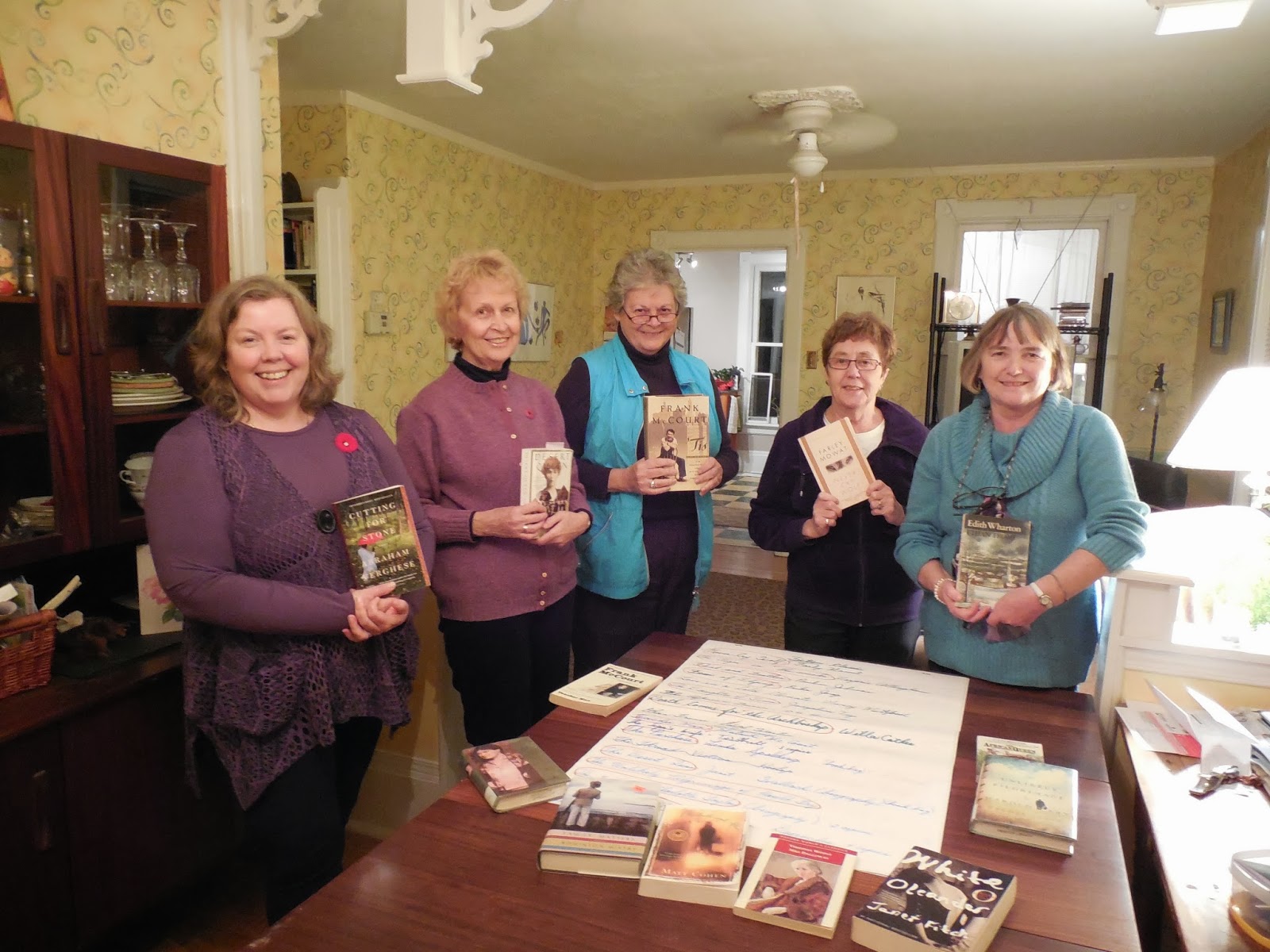
In 15 years, we have read many of the well-known classics.  However, this group has no problem finding new options, and this year, it seems, they chose such obscure books that we cannot get enough copies to read.  The library system discarded them long ago. Guess they weren't favourites for anyone else.  But we may revive them - if we can just find a copy!